
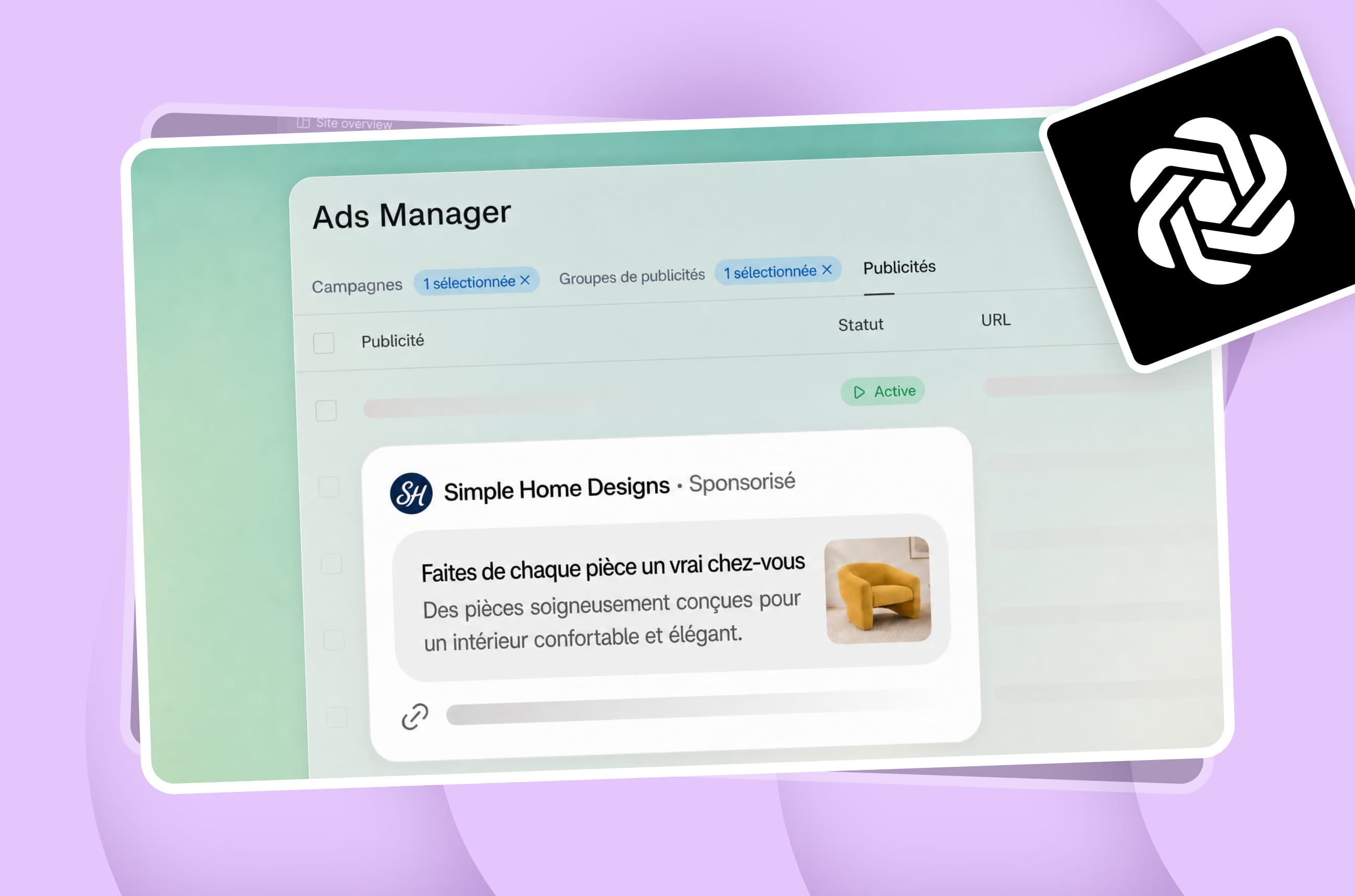

This article published by Agence Norry compares ChatGPT Ads and GEO to help SME and mid-sized company leaders choose the right visibility strategy on AI engines. It explains how OpenAI's ad platform works, its pricing, its formats, its limits in France, and why GEO remains the most actionable lever for the vast majority of French companies in 2026.
📊 Key figures
IndicatorFigureSourceChatGPT Ads launchFebruary 9, 2026OpenAISelf-serve Ads Manager openingMay 5, 2026OpenAIAverage recommended CPC$3 to $5 per clickOpenAI Ads ManagerInitial CPM$25 to $60 per 1,000 impressionsDataiads / IOqueryObserved CTR0.91% (vs 6.4% Google Search)Dataiads, February 2026Conversion rate vs other channelsx1.5 better than averageCriteo, 500 US retailersActive brands in the pilotOver 600La Fusée, July 2026Availability in FranceNot yet openOpenAI, August 2026
ChatGPT Ads: what it really is
Since February 9, 2026, OpenAI has been displaying ads in ChatGPT. Sam Altman had long ruled out this option. OpenAI's operating deficit, estimated at $14 billion in 2026, accelerated the timeline.
The format is unique: a sponsored card (chat_card), clearly labeled “Sponsored”, displayed below the AI's answer. It doesn't alter the generated content. OpenAI calls this principle answer independence: ChatGPT's answers remain independent of advertisers.
Only free accounts (Free and Go at $8/month) see ads. Paid plans are exempt. OpenAI has also been serving ads to logged-out users since late April 2026.
How targeting works
ChatGPT Ads doesn't rely on exact keywords, audiences or browsing behavior. Targeting is purely contextual and conversational via context hints: descriptive phrases that describe the user's intent in the conversation.
Example: rather than targeting the keyword “web agency”, an advertiser describes “user looking for a provider to redo their e-commerce site”. It's closer to semantic targeting than to classic search.
The bidding system is a relevance-weighted second-price auction: the advertiser who pays the most doesn't win, but the one whose ad is the most relevant in the context of the conversation does.
Pricing and access
At launch, the entry ticket was $200,000 to $250,000. It dropped to $50,000 in April 2026, then to zero on May 5, 2026 with the opening of the self-serve Ads Manager. The channel is now accessible via the direct platform, via Criteo, via Shopify Shop Campaigns, or via certain partner agencies.
In France, the platform is not yet open as of August 12, 2026. OpenAI hiring in Paris, Munich and Dublin in July 2026 suggests preparation for the European market, with no official date announced.
GEO: the free alternative most companies haven't tapped yet
GEO (Generative Engine Optimization) refers to all the practices that allow you to be naturally cited in the answers of AI engines: ChatGPT, Gemini, Perplexity, and Google's AI Overviews.
Language models favor content that is structured, factual, clear, covers a topic in depth, and is cited by other sources. A company that works on these signals sees its name appear in answers, without paying for each appearance.
It's a different logic from advertising: the appearance isn't bought, it's earned. It builds up over time, whereas an ad campaign stops when the budget stops.
The full comparison: ChatGPT Ads vs GEO
ChatGPT AdsGEOCost$3-5 CPC / $25-60 CPM$0 per appearanceInitial investmentAd production, campaign managementContent production, technical optimizationResultSponsored card below the AI answerCitation within the body of the AI answerVisibilityClearly identified as advertisingPresented as a natural referenceTargetingContextual via context hintsIndirect via content relevanceTime to resultsImmediate once activated3 to 9 months (cumulative)Duration of effectStops when the budget stopsBuilds up over timeAvailability in FranceNot yet openActionable todayEngines coveredChatGPT onlyChatGPT, Gemini, Perplexity, Google AI OverviewsCTR / conversionCTR 0.91%, x1.5 conversion vs other channelsUp to 35% if cited in AI OverviewsLevel of controlHigh (budget, timing, message)Indirect (you optimize, you don't control)
The 0.91% CTR on ChatGPT Ads may seem low, but traffic from LLMs converts 1.5 times better than other channels according to Criteo. The quality of the click partly offsets the lower volume.
ChatGPT Ads: for whom, for what
Classic advertising logic applies: ChatGPT Ads makes sense when the acquisition cost is lower than the value generated. With a CPC of $3 to $5 and traffic that converts 1.5 times better than average, the channel is competitive for high average order values or services with high customer lifetime value.
It's poorly suited to small tickets, undifferentiated offers, or companies without a dedicated landing page. The most commonly documented mistake: copy-pasting Google Ads copy and redirecting to the homepage. The winning copy follows the pattern “Brand: Benefit with a quantified data point” with a landing page calibrated for conversational intent.
For French companies, the question is mainly forward-looking. Arrival in France implies compliance with GDPR and the Digital Services Act, which slows the European rollout.
GEO: for whom, for what
GEO is for any company that wants lasting visibility in AI engines, regardless of their advertising budget. It's also the only actionable lever in France today for appearing in ChatGPT.
It's particularly relevant for B2B companies, service providers, and expert brands that want to establish topical authority. Where advertising manages existing demand, GEO creates demand upstream, by being present when a prospect asks a question before even knowing which brand to contact.
Its main drawback is the delay: 3 to 9 months before stable results. It's not an emergency lever. It's a long-term investment, as SEO has been for twenty years.
What this means now
ChatGPT Ads and GEO are not in competition. They are two different levels of the same AI visibility strategy. The best-positioned brands in two years will be those that worked on both: an organic presence built through GEO, occasionally reinforced by targeted advertising campaigns.
For French companies in 2026, the priority is clear: start GEO now, while competition is still low, and prepare your assets for ChatGPT Ads for when the platform opens in Europe. Waiting for both to be available means leaving the field to competitors who started earlier.