
This article, published by Agence Norry, analyzes the announcement of Source by Webflow, the new agentic platform unveiled at Webflow Conf on September 2, 2026. It explains what Source is, its key features (Views, performance-monitoring agents, governance), its research preview availability, and what this shift concretely means for companies that use Webflow.
On September 2, 2026, at Webflow Conf in Boston, Webflow unveiled Source, a new platform designed to let marketing teams and AI agents work side by side, and together, in a single environment. It is by far the most significant announcement of this edition: it sets out the direction Webflow is taking for the coming years, and therefore how agencies will need to work with the tool.
What exactly is Source?
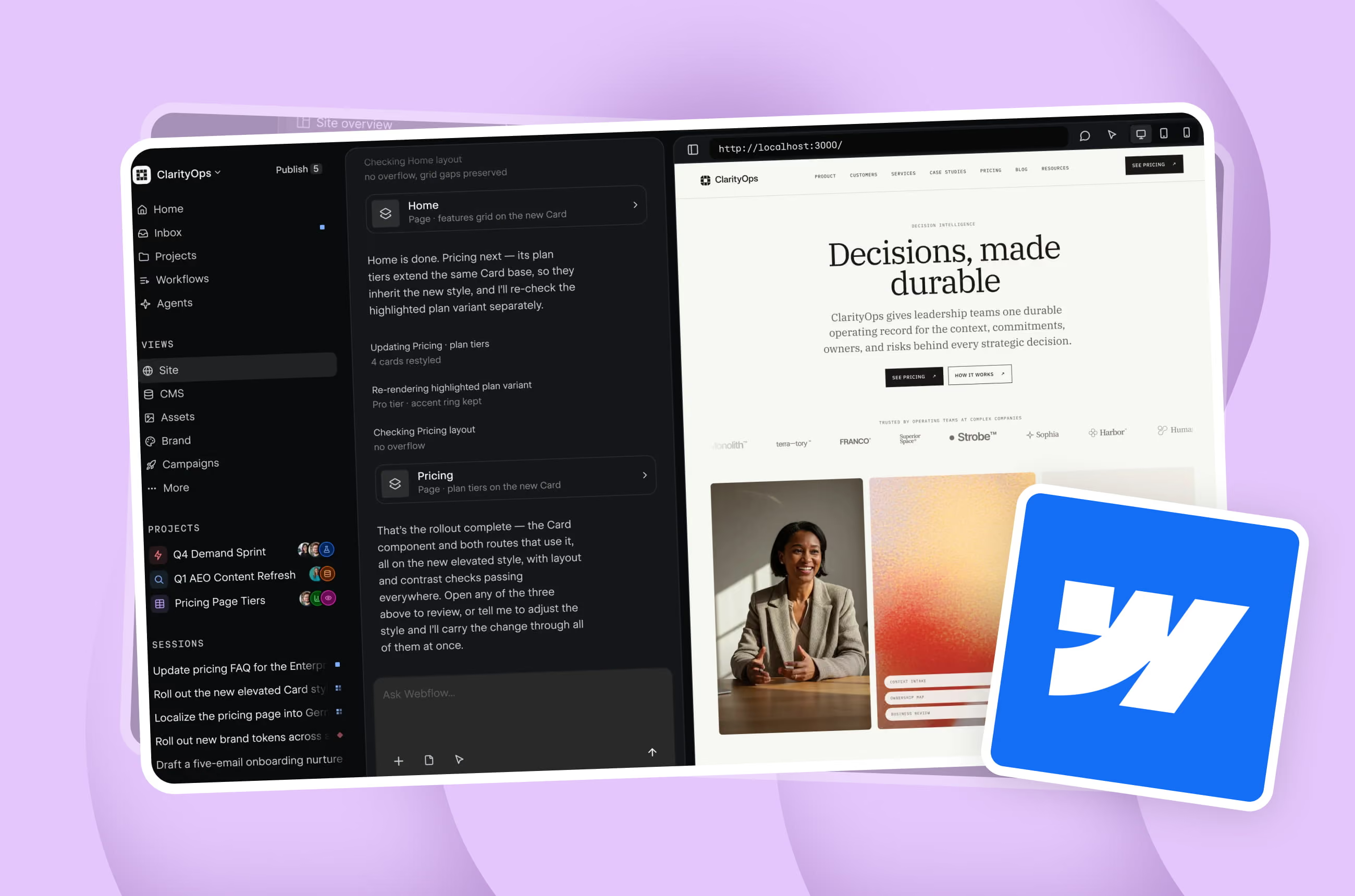
Webflow describes Source as an agentic platform: a workspace where a site's code becomes the common foundation that both humans (marketers, designers, developers) and AI agents build on. Instead of letting agents act only through visual abstraction layers, as the classic Webflow editor does, Source gives them direct access to the code. The announced result: agents capable of handling broader and more complex changes, without being held back by the usual limits of a no-code tool.
Webflow CEO Linda Tong summed up the ambition in a single sentence: as code becomes commoditized thanks to AI, “it's craft, and the teams that amplify it, that will set the best brands apart from the rest.” Source is not meant to replace teams, but to give them, in her words, “new superpowers.”
The key features announced
- Views (customizable workspaces): a tailored interface for each role, covering visual building, campaigns, content and optimization.
- Performance-monitoring agents: continuous monitoring of the site and campaigns, with alerts and recommendations based on historical data.
- Composable layer: connection to existing code, the CMS, hosting and the martech stack (CRM, campaign tools, etc.).
- Governance and guardrails: brand standards, permissions and business rules governing what agents can deploy.
- Real-time activity logs: full visibility into agents' actions, directly on the canvas.
| Feature | What it enables | Who is it for? |
|---|---|---|
| Views | Role-based custom workspace | Marketers, designers, developers |
| Performance agents | Continuous monitoring and automatic recommendations | Marketing and growth teams |
| Composable layer | Connection to your existing code, CMS and martech stack | Companies with an existing digital ecosystem |
| Governance | Permissions and business rules for deployments | Marketing and IT leadership, agencies |
| Activity logs | Real-time visibility into the agents' work | The whole team |
Matt Varughese, partner and head of the agency 8020, quoted in the announcement, sums up the benefit on the agency side in a telling phrase: giving every team member “a view of only what they need to touch,” while running agents “with real guardrails, so the work keeps moving while you sleep.”
Other announcements that complete the picture
Source doesn't arrive alone. Webflow used its conference to unveil a whole ecosystem of tools that revolve around the same agentic logic:
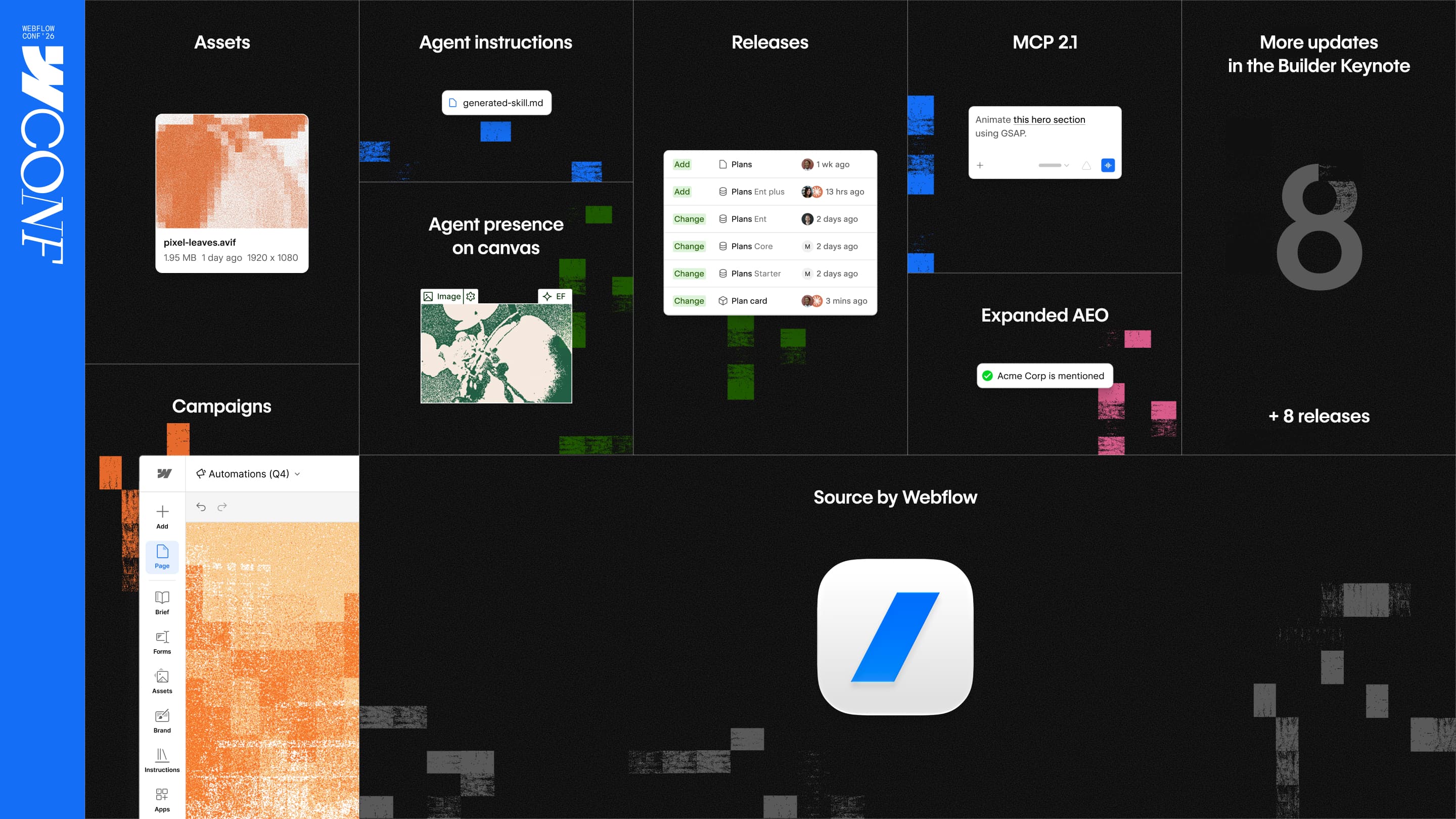
- Webflow Campaigns: generation of landing pages, variants and ad creatives from a simple brief, with HubSpot and Salesforce integrations. In beta starting fall 2026.
- Assets: production of visuals and videos consistent with your brand identity at scale, powered by Vidoso technology.
- AEO improvements: content agents able to identify the topics on which competitors are cited by generative AI, and to write original content in response.
- MCP 2.1: broader agent access to GSAP interactions, CMS queries and deployment on Webflow Cloud.
- Branching: a tool to prepare and test complex updates before publishing them.
Availability: where do things stand today?
Source is currently offered as a limited research preview: interested teams can apply through the dedicated program on Webflow's website. No general availability date or pricing has been announced at this stage. Expect a testing and adjustment phase before a wider rollout, which is rather reassuring for a feature that directly touches production code.
What this concretely changes for companies that use Webflow
- A real operational time saver. AI on Webflow is no longer limited to generating a page or suggesting a text. It settles in as a collaborator able to act directly on the site, continuously: creating landing page variants, adjusting content, ongoing optimization, without systematically waiting for a classic development cycle.
- A governance topic to frame seriously. Giving agents direct access to the code, even when bounded by permissions and business rules, is a decision with consequences. Companies that adopt Source will need to clearly define their brand standards, their validation rules and who is allowed to do what. This framing work is very similar to what we already do with our clients when structuring a design system or content governance.
- Human expertise remains central. Agents can speed up execution, but strategy, brand identity, user experience and the overall consistency of a site remain topics that call for perspective. That is precisely what Linda Tong emphasized when she spoke of “craft” as the differentiating factor.
Our take at Norry
This announcement confirms what we are already seeing with our clients: no-code tools like Webflow are no longer just alternatives to traditional development; they are becoming full-fledged platforms, with their own automation and AI ecosystem. On the one hand, it is becoming increasingly worthwhile to rely on a partner who masters not only Webflow design and development, but also these new agentic layers. On the other hand, the real added value of an agency will not disappear with the arrival of these tools: it is shifting toward strategy, structuring and steering these technologies in service of clear business goals.
We are of course keeping a close eye on the rollout of Source in the coming months, and we will be sure to share our feedback as soon as we have been able to test the platform in real-world conditions.