ChatGPT
 Grok
Grok
 Perplexity
GEO
8 min
AI Overviews in France: what just changed in Google, and what your business needs to do now

Pauline Viseur

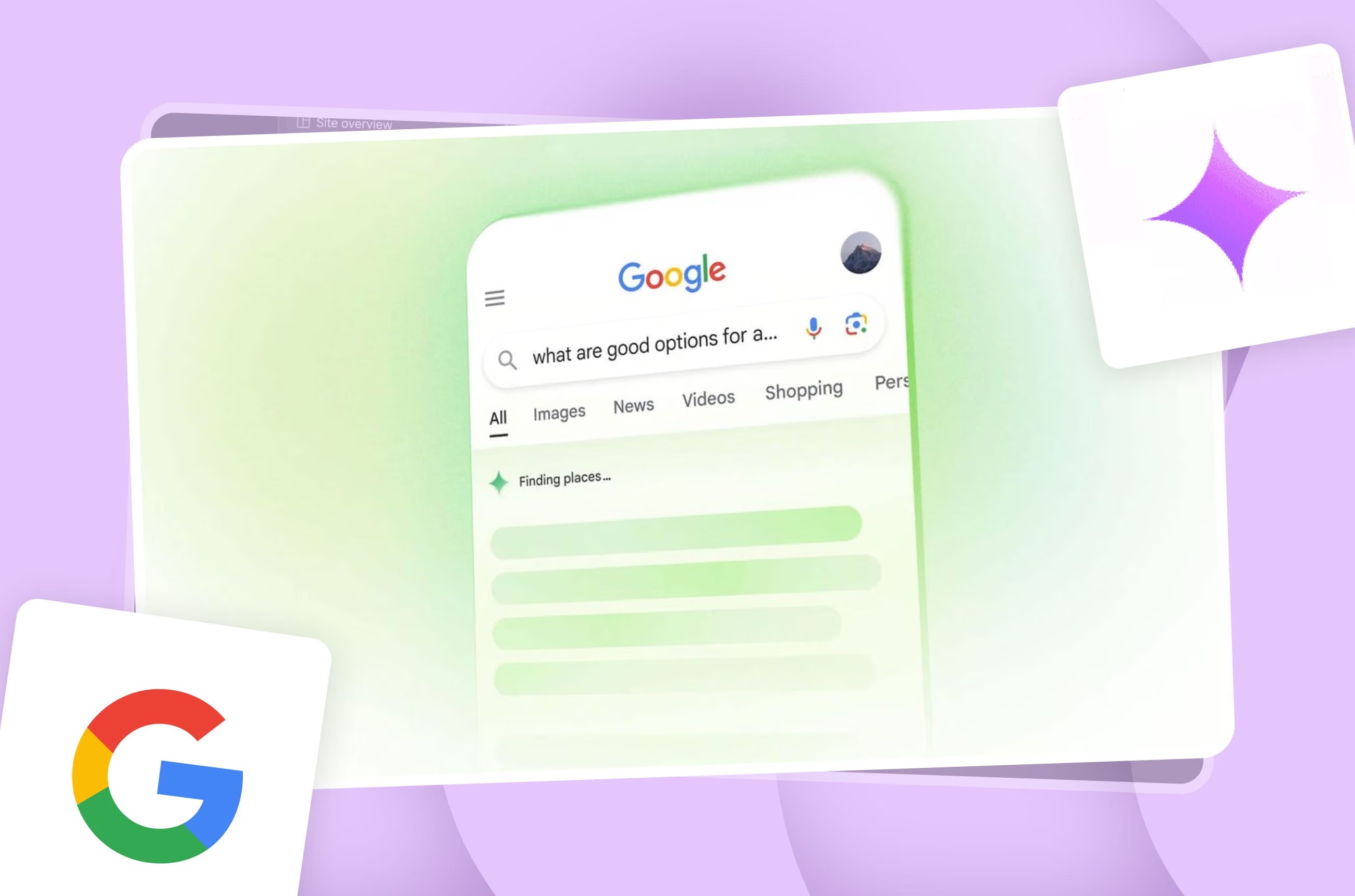
This article analyzes the arrival of Google's AI Overviews in France on July 22, 2026. It compares AI Overviews to featured snippets, details the quantified impact on organic traffic, explains which types of content are most exposed, and provides priority actions to maintain visibility in this new environment.
On the morning of July 22, 2026, Google activated AI Overviews in France. The search results page your customers see changed overnight. Here is what is happening, what the numbers say, and what you need to do.
58% of Google queries display an AI Overview in 2026 (vs 16% at the end of 2024)
−61% average organic CTR on queries with AI Overviews (source: Seer Interactive, 53 brands)
2 billion monthly AI Overview users worldwide as of May 2026
80% of sources cited in an AI Overview are already in the organic Top 10
Before we go any further, let's establish a clear definition. An AI Overview (formerly known as SGE: Search Generative Experience) is a response block generated by Gemini, Google's AI model. It appears at the very top of the results page, before the usual ten links.
When a user asks a question, Google no longer just lists pages. It synthesizes a response built from multiple sources, places it at the top of the page, and directs users to sites via links embedded in the summary.
Note: Featured snippets dropped by 83% between January and June 2025. AI Overviews have largely absorbed them. In 2026, they appear on 84% of informational queries compared to 32.5% for featured snippets.
France was the only major market without AI Overviews, even though the feature was active in over 120 countries. Two rulings by the Competition Authority had blocked the rollout: 500 million euros in 2021, followed by 250 million in 2024 for training Gemini on press content without an appropriate agreement.
A framework negotiated with authorities and publishers finally allowed for the launch on July 22, 2026. Publishers who have signed a neighboring rights agreement have had their contracts extended with compensation calculated based on "AI impressions." The rollout will be gradual until September 23, 2026.
Data has been available in the United States for two years. It all points to the same conclusion: a high ranking is no longer enough to guarantee traffic.
A nuanced point: ALM Corp reports that the CTR floor appears to be stabilizing in early 2026. The clicks that remain convert 23% better (source: Digital Applied 2026)—users who click have already read a summary and are looking to dive deeper.
Publishers can technically opt out of having their articles power AI summaries while remaining indexed in standard search results. However, this choice is not without consequences.
Refusing to be cited means losing visibility in the summary and the associated clicks (up to 35% CTR for cited sources). Accepting means feeding a system that cannibalizes a portion of the clicks to your own site.
For businesses (outside of media), the question is different. Being cited in an AI Overview for a relevant commercial query represents significant exposure, even without an immediate click. Not being there means letting AI recommend your competitors instead of you.
The rollout continues through September. This is your window to get ahead. Here are the priority actions, in order.
Before the rollout is complete, establish a baseline. Identify your pages that rank for informational queries, check which ones are already triggering an AIO, and note whether you are cited. Google Search Console will show CTR trends in the following weeks. Without a baseline today, you won't be able to measure the actual impact.
80% of sources cited in AIOs are already in the Top 10. SEO remains necessary, but it is no longer sufficient. Gemini favors pages that answer a question directly with a clear structure, verifiable data, and comprehensive topic coverage. Well-marked FAQ blocks (schema.org FAQPage), explicit headings, and short, dense paragraphs are the formats best ingested by the system.
AI Overviews highlight the risks of relying solely on organic Google traffic. Now is the time to strengthen direct channels: email lists, communities, and editorial partnerships. Branded keyword traffic is the least exposed to AIOs (only 4.79% trigger an AIO). Investing in brand awareness is also a way to protect your search traffic.
Original surveys, exclusive data, expert interviews, detailed case studies, and field experience reports: these are the types of content that AI cites but cannot replace. An AI summary can say "according to a Norry study," but it cannot replace the study itself.
Google's AI Overviews, ChatGPT's responses, and Perplexity's summaries: three manifestations of the same phenomenon. Users get a structured answer before even visiting a website.
The good news: the levers are largely the same. Structuring your content to be cited in a Google AI Overview also improves your visibility on ChatGPT and Perplexity. A well-executed GEO strategy covers both fronts simultaneously.
Norry offers an AI visibility audit that covers Google AI Overviews and generative engines (ChatGPT, Gemini, Perplexity). We measure your citation share, identify your most exposed pages, and build a concrete action plan.
An AI Overview is a response block generated by Gemini that appears at the very top of Google results, before standard links. It synthesizes an answer from multiple web sources and links to them via embedded citations. It does not appear for every query: Google reserves it for searches that are sufficiently specific or complex.
Data from markets where AI Overviews have been active for two years shows organic CTR drops ranging from 15% to 61%, depending on the study and query type. Generic informational content is the most vulnerable. However, the clicks that remain convert 23% better on average: users who click have already read a summary and are looking to dive deeper.
80% of sources cited in AI Overviews are already in the top 10 organic results. SEO remains a necessary foundation, but it is no longer enough. Gemini prioritizes pages that answer a question directly with a clear structure, comprehensive topic coverage, and appropriate technical markup: schema.org, structured FAQs, and explicit headings. Generic, easily summarized content is the most exposed to cannibalization.
For the most part, yes. Featured snippets dropped by 83% between January and June 2025, largely absorbed by AI Overviews. In 2026, AI Overviews appear on 84% of informational queries, compared to 32.5% for featured snippets. The two can coexist, but their combination is the worst-case scenario for organic CTR, with drops of up to 37%.